


Creating a signature guitar tone is not just about picking a high-gain amplifier or adding lots of effects to the signal chain. For an experienced guitarist, the sound comes from the choice of amplifier, cabinet and microphones, and from how each effect works within a single chain.
In the MasterClass: Crafting Your Signature Sound session, legendary Indonesian guitarist Eet Sjahranie shares his approach to building a guitar sound with the NUX MG-50Li.
From an unusual amplifier and cabinet combination and the choice of microphones for the impulse response, to the scene setup for rhythm and lead, this session shows how musical experience plays a big part in shaping a signature tone.
Eet Sjahranie's Philosophy: Head and Cabinet as the Foundation of Sound

One interesting part of Eet Sjahranie's approach is that he always uses an amplifier head and a cabinet separately.
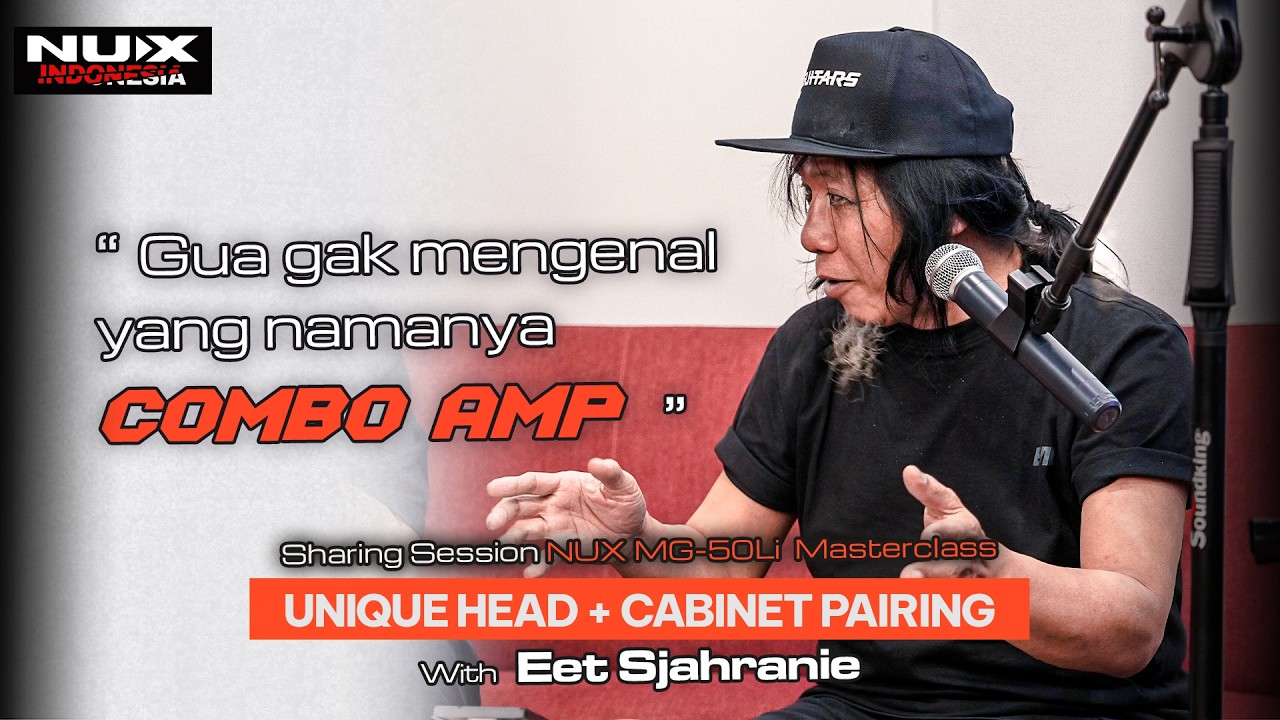
"I don't know the word 'combo'. For me it's a head and a cabinet, always."
That statement describes an approach that has long been part of how Eet builds his guitar sound.
That does not mean combo amplifiers are not good. But a separate head and cabinet is simply the approach he is most familiar with when shaping a sound.
With the NUX MG-50Li, that concept can be applied digitally by choosing the amplifier model and the cabinet impulse response independently. This lets guitarists explore many amplifier and cabinet combinations without being limited by what is "normal" or what "should" go together.
An Unusual Pairing: SLO Amp and DIZ Cabinet

One of the most interesting parts of Eet Sjahranie's preset is the SLO amplifier model paired with the DIZ cabinet. The combination is unusual because the two come from different characters and eras.
Why Choose the SLO Amplifier?
Choosing the SLO was not just about familiarity. Eet explained that he tried many of the available amplifier models before settling on the SLO character that fits his needs.
According to Eet, this amplifier tends to sound darker, especially in its high-frequency response. That is exactly what interested him.
Instead of looking for an amplifier with treble that jumps out right away, Eet picks a darker base character and then adjusts the high and presence parameters to get the tonal balance he wants.
In his setup, the bass parameter is kept relatively low, and deep is even set to zero. The goal is to keep the low frequencies from getting excessive or boomy.
This approach shows that setting up a high-gain amplifier is not only about how much distortion you have, but also about how each frequency is controlled.
The DIZ Cabinet with Dual Microphones
After settling on the amplifier, Eet moved on to choosing the cabinet impulse response. He ended up with the DIZ cabinet in a two-microphone configuration, using two microphones with different characters:
- Dynamic Microphone 57: placed at the cap edge to capture a focused, clear sound with midrange definition.
- Ribbon Microphone 121: used as a complement for a smoother character that helps balance the high frequencies.
The combination of a dynamic 57 and a ribbon 121 is a microphone technique widely used when recording electric guitar. The dynamic microphone gives articulation and clarity, while the ribbon microphone can add body and a softer tonal character.
In the session, Eet explained that he chose the microphones by ear. Not because he was following a certain setup, but because that combination gives the sound he prefers.
Breaking Down Eet Sjahranie's Signal Chain on the NUX MG-50Li

Besides the amplifier and cabinet combination, the order of effects is also an important part of Eet Sjahranie's signature tone.
Interestingly, the signal chain he uses takes a classic, old-school guitar rig approach, with some empty slots left for future development.
Signal Chain Order
In outline, Eet's preset uses the following chain:
Noise Gate → Wah → Phaser → Studio Compressor → Tube Screamer → SLO Amplifier → DIZ Cabinet IR → Send/Return → Detune → Volume Pedal → Digital Delay
Some of the effects in the chain are switched on or off depending on the playing needs and the scene being used.
Phaser at the Start of the Signal Chain
One interesting choice is placing the phaser before the amplifier. When it is switched on, the phaser produces a modulation character similar to a soft wah, giving a distinctive tonal movement without having to work a wah pedal by hand.
This placement reflects a classic guitar effects approach that has long been part of exploring rock sounds.
Tube Screamer as a Booster
The Tube Screamer is placed before the SLO amplifier. In a high-gain setup, an overdrive like the Tube Screamer can help shape the amplifier's input response, emphasize the midrange and keep the distortion focused.
The final result still depends on the gain, tone and level settings.
Send/Return for Effects Flexibility
Eet also includes two send/return blocks in his preset. Interestingly, those blocks are not always in permanent use.
According to Eet, when building a rig he always leaves room for effects he might add later. Effects such as a flanger or a harmonizer are examples of gear that can be added as the music requires.
This approach keeps the signal chain flexible without having to rebuild the whole preset.
Studio Compressor: The Key to Lead Guitar Sustain and Consistency
When moving from rhythm to lead, one of the effects that gets switched on is the Studio Compressor. Eet explained that the compressor plays an important role in keeping his volume and playing response consistent.
In lead playing, each note can be picked with a different intensity. The compressor reduces those level differences so the sound feels more stable.
It can also improve the perception of sustain, especially when playing long notes or melodic phrases.
Why the Studio Compressor?
Eet chose the Studio Compressor because, in his experience, that model gives the most even compression response of the options he tried.
By placing the compressor before the booster, the guitar signal is controlled first, before it goes into the overdrive and the amplifier.
This setup helps build a more consistent lead character that suits Eet's playing needs.
NUX MG-50Li Scene Switching: Rhythm to Lead with No Mute Gap

One NUX MG-50Li feature shown in this session is the ability to switch scenes without an annoying gap in the sound. With the scene feature, several effect blocks can be controlled at once with a single button.
In Eet Sjahranie's preset, the scene setup is used to separate rhythm and lead needs.
Rhythm Scene
Used for rhythm playing, with an effects setup adjusted to keep the guitar focused and defined.
Lead Scene
Switches on several effect blocks at once, including the compressor, for a lead sound with sustain and response better suited to guitar solos.
In the demonstration, a single scene button changed the state of four effect blocks.
Another advantage is that the scene change happens with no mute gap, so playing can continue without interruption when changing sounds.
This feature is very useful for guitarists who need a fast transition from rhythm to solo, especially in live performances.
High-Gain Tone and Noise: Part of the Playing Character
In the demonstration, Eet also explained that he is used to playing with high gain settings. As a result, noise can show up as part of how the rig responds.
However, through experience and playing technique, Eet has learned to control that noise, including with muting techniques.
This shows that the end result of a guitar tone is not decided only by the preset or the gear. Picking technique, muting, dynamics control and the player's experience also have a big influence on the sound.
Digital Delay and the Old-School Guitar Rig Approach
At the end of the signal chain, Eet uses a Digital Delay. Again, this choice comes from habit and familiarity with the gear he has used for years.
When he tried the digital version on the NUX MG-50Li, Eet felt the character and response were familiar enough to the rig approach he normally uses.
Overall, this preset shows that modern digital technology can be used to build a signal chain with a classic philosophy. It is not about using as many effects as possible, but about choosing gear that truly supports your playing character.
Build Your Signature Guitar Tone with the NUX MG-50Li
There is one important thing to learn from the session with Eet Sjahranie: a signature tone does not always come from a popular combination of gear, but from the courage to explore sound by your own ear and your own musical needs.
The choice of a darker SLO amplifier, a DIZ cabinet with a dynamic and ribbon microphone combination, and the use of the Studio Compressor for lead all show that every decision has a purpose.
With its signal chain flexibility, amplifier and cabinet choices and scene switching, the NUX MG-50Li gives guitarists room to explore and build their own sound.
Watch the Full Master Event on the NUX Indonesia YouTube Channel
Curious how Eet Sjahranie's preset sounds when played live on the NUX MG-50Li? Watch the full discussion on choosing the amplifier, the cabinet impulse response, the effects setup and the scene switching demo in the session Crafting Your Signature Sound – Head + Cabinet Unique Pairing ft. Eet Sjahranie.
Find inspiration to build your own signature tone with NUX Indonesia.