


How far can we explore a guitar tone?
When creating a unique guitar sound, conventional approaches are not always enough. For guitarists who enjoy experimenting, understanding how each part of the signal chain interacts can open up new possibilities for sound design and tone shaping.
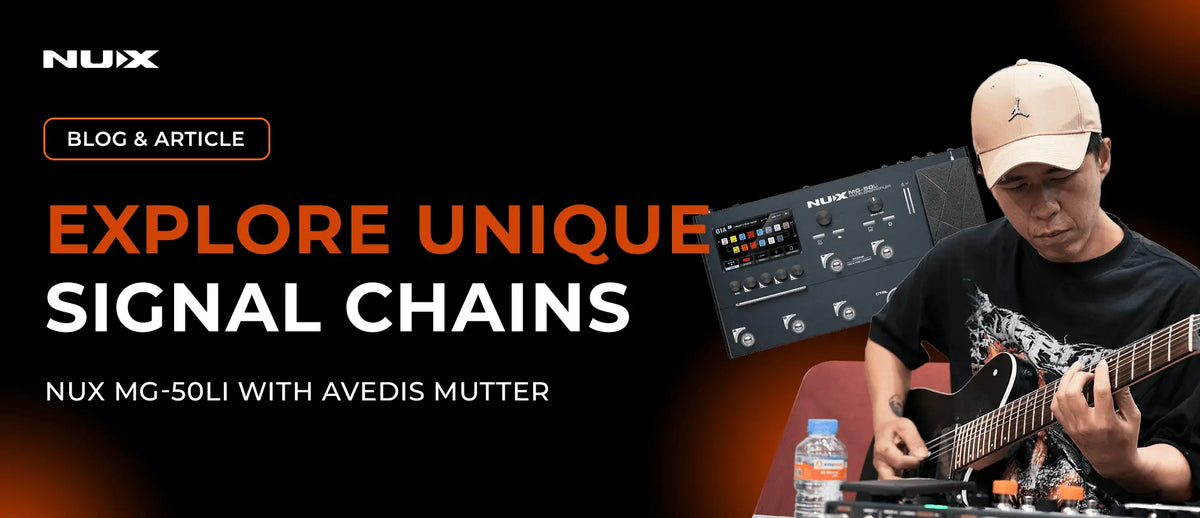
This was one of the interesting topics explored during the NUX MG50Li Masterclass at Salomo Musik, where NUX Artist Avedis Mutter experimented with a preset using an unconventional approach.
Instead of using a traditional linear signal chain, Avedis took advantage of the parallel signal chain on the NUX MG50Li to combine two very different tone characteristics.
When Extreme Guitar Tone Becomes Part of the Solution

Avedis draws inspiration from the modern guitar sounds of bands such as END and Knocked Loose, as well as the production approach of Will Putney, which can make an extremely aggressive fuzz character sound musical and engaging.
According to Avedis, achieving this type of guitar tone is not always a simple process.
A fuzz tone that is too extreme can lose definition and become difficult to enjoy. However, reducing the fuzz character too much can also remove the aggressive character that makes the tone interesting in the first place.
This is where experimenting with a parallel signal chain becomes particularly interesting.
"Extreme, but controlled."
This concept became the foundation of the preset Avedis created during the masterclass session.
Using the Parallel Signal Chain on the NUX MG50Li

With the NUX MG50Li, the signal chain does not always have to run linearly from one effect block to the next.
Using Chain 2, the signal can be split into two separate paths that are processed independently.
In the preset created during the session, the signal starts from the guitar and passes through a Noise Gate before being divided into two paths.
Chain A uses a hi-gain character boosted with a Tube Screamer. This produces a more familiar, tight, and controlled guitar tone.
Meanwhile, Chain B uses a fuzz effect with a much more extreme character.
When played separately, the two signal paths have very different characteristics. However, when combined, each path serves a different purpose in shaping the overall guitar tone.
The signal from Chain A maintains the definition and main character of the tone, while Chain B adds a more aggressive layer of fuzz texture.
The result is a more complex guitar tone that combines a familiar foundation with a more extreme sonic element.
It's Not Just About Adding More Guitar Effects

This experiment demonstrates that sound design is not always about adding more effects to a signal chain.
What matters more is how each element is used and how the signal is processed.
In a traditional series configuration, placing a Tube Screamer, fuzz, and amplifier one after another can cause the characteristics of each effect to stack on top of each other. The result can become overly saturated, muddy, and difficult to control.
With parallel routing, the two tone characteristics can first be processed independently and then blended according to the desired result.
This allows guitarists to control how dominant the fuzz character should be without sacrificing the main character and definition of the guitar tone.
In Avedis' preset, the hi-gain path remains the dominant character, while the fuzz path works as an additional layer that provides more texture and aggression.
Creating New Possibilities for Guitar Sound Design
For NUX, this type of flexibility is an important part of the experience of using the MG50Li multi-effects processor.
A multi-effects processor is not only about how many effects are available. It is also about how freely guitarists can combine and arrange those effects to create their own sound.
A parallel signal chain enables approaches that can be difficult to achieve with a conventional series routing setup. Different amplifier characters, effects, or processing chains can be combined to create a more complex and personal guitar tone.
Avedis' experiment at Salomo Musik is an example of how the routing capabilities of the NUX MG50Li can be used not only to follow conventional signal chain configurations, but also to develop new approaches to guitar tone creation.
Explore Your Own Signal Chain
There is no single formula that works for every guitar tone.
A tone that sounds "wrong" when played on its own can become an important part of the overall sound when placed within a complete signal chain. In the same way, an extreme effect can become a defining element of a guitar tone when combined with the right routing and blending approach.
Through the NUX MG50Li, guitarists have more room to experiment with how they build and shape their sound.
Ultimately, great guitar tone is not only about the gear you use. It is also about how effectively you understand and use the capabilities of your gear.
Build Your Own Guitar Tone with NUX
Exploring guitar tone is about more than simply adding more effects. Understanding signal flow, routing, blending, and the interaction between different effects can help you create a sound that is both distinctive and controlled.
The NUX MG50Li gives guitarists the flexibility to experiment with different signal chain configurations and develop their own approach to sound design.
Whether you are building tones for live performance, recording, or personal experimentation, exploring the possibilities of your signal chain can be the first step toward creating a truly personal guitar sound.
Explore the NUX MG50Li and discover more NUX products at NUX Indonesia.