


Building a guitar rig today can be done in more ways than ever.
You can start with a single overdrive, then add distortion, delay, reverb, modulation, and more pedals until you end up with a pedalboard that truly matches your taste and needs. There's a specific kind of satisfaction in finding the right pedal combination and landing on a tone that finally feels "yours."
But there's also a more practical route. A single digital multi-effects unit can handle a huge range of functions in one device. Amp, cab or IR, drive, modulation, delay, reverb, even fairly complex routing can all live inside a single preset, ready to recall anytime.
The two approaches work very differently.
It's not just about how many pedals are on the floor — it's also about how you shape your tone, manage your signal chain, switch sounds on stage, and move your entire rig from one place to another.
Before comparing the two, there's one thing worth clearing up.
Stompbox doesn't always mean analog, and multi-effects doesn't always mean a big unit covered in footswitches.
Some stompboxes run on digital processing, and some digital multi-effects units are shaped like stompbox pedals. So this isn't really an analog vs. digital conversation.
What we're actually looking at is two different ways of building a rig: combining several stompboxes, each with its own dedicated function, versus using one digital multi-effects unit to handle multiple parts of the signal chain.
So what actually separates the two in everyday use? Which is more practical? What about cost? How does it feel to shape your tone? What happens when you use them for live performance or recording? And as your needs grow over time, which one adapts more easily?
Rather than chasing an absolute "which is better," it's more useful to look at the strengths and trade-offs of each approach, then figure out which one actually makes sense for how you play.
What's the Real Difference Between the Two?
In simple terms, the main difference comes down to how you build your signal chain.
With stompboxes, you build your rig using several separate devices, each usually handling one specific function. One pedal for overdrive, another for delay, another for reverb, and so on. All of those devices are then connected together into one signal chain.
For example:
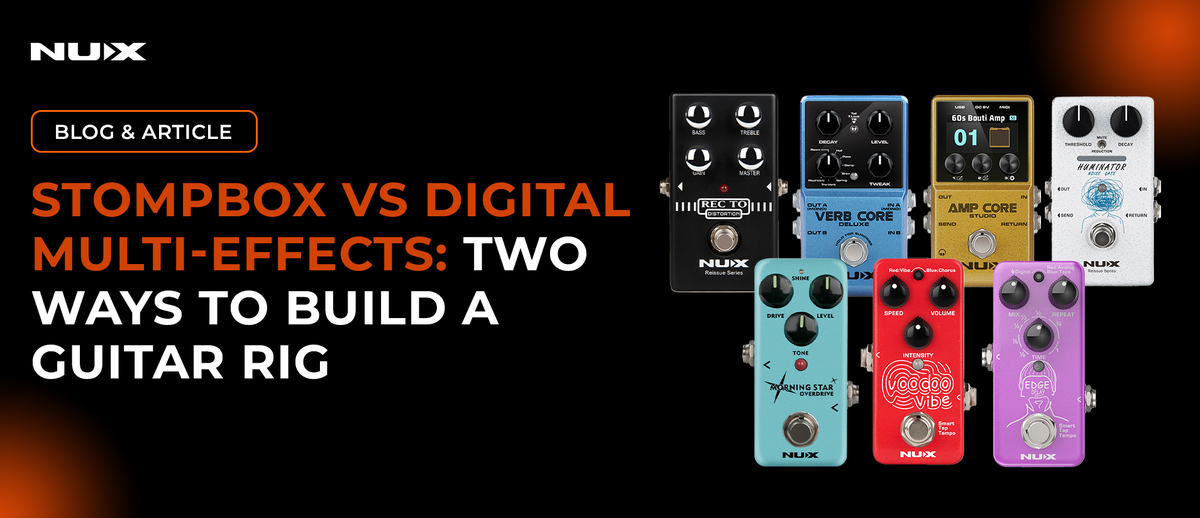
GATE (NUX Humimator) → Overdrive (NUX Morning Star) → Distortion (NUX Recto Distortion) → Modulation (NUX Voodoo Vibe) → Delay (NUX Edge Delay) → Reverb (NUX Verb Core) → Amp / Amp Sim Pedal (NUX Amp Core Studio)

If you want to add a new effect, you have to add a new pedal into the chain. Likewise, changing your tone character usually means swapping or adjusting a specific pedal, and sometimes rearranging part of the rig you already built.
Digital multi-effects takes a different approach. The various functions that would normally require several separate devices all live inside a single unit. You build your signal chain virtually, choosing the effects you need, arranging their order, and saving the result as a preset.
For example, with a single NUX MG Series unit, you could build a chain like:
Gate → Compressor → OD → Amp → IR → Modulation → Delay → Reverb

Within a single device, you get several amp options, various types of drive and modulation, delay, reverb, cab simulation or IR loading, and more. Depending on the unit, that signal chain can also be configured with fairly complex routing.
This difference then shapes how you actually use your rig.
With stompboxes, changes usually happen at the hardware level. You step on a pedal, turn a knob, swap a pedal, or add a new one.
With digital multi-effects, changes happen more at the preset and signal-chain level. You can switch several parts at once, save different configurations, and recall them whenever you need them.
Take live performance as an example. With a pedalboard, you might combine several footswitches to go from clean to drive, then kick in delay or reverb. With multi-effects, that same change can be stored in a preset or scene, so multiple parameters and effect blocks shift all at once.
So the difference isn't just "lots of pedals vs. one device."
Stompboxes offer a more modular approach — every part of the rig stands on its own and can be chosen, swapped, or expanded as needed.
Digital multi-effects offers a more integrated approach — different parts of the signal chain live inside one system and can be configured and recalled as a single unit.
From here, it becomes clear that the two don't just offer different ways of shaping tone — they offer fundamentally different ways of building and operating a guitar rig.
Flexibility: Freedom to Assemble or Freedom to Configure?
This is interesting because both approaches are genuinely flexible — that flexibility just comes from different places.
With stompboxes, flexibility mainly comes from being modular. You're free to choose each part of your rig independently. Overdrive from one brand, delay from another, plus whatever modulation or reverb you want — all of it can be combined however you need.
With digital multi-effects, flexibility comes more from the sheer number of options and the configuration capability packed into one device. You don't need to physically swap hardware to try a different signal chain. Just pick the blocks you need, rearrange their order, and save that configuration as a preset.
Freedom to Choose Each Component
Stompboxes shine when it comes to the freedom of choosing each component individually.
If you love a specific overdrive's character but want to pair it with a delay from a different brand, that's no problem. Even when you find a new pedal that fits your needs better, you can swap out just that one piece without touching the rest of your rig.
That makes a pedalboard feel like a system that can keep evolving.
Many Choices in One Unit
Multi-effects takes a different approach.
Instead of choosing devices one at a time, you get a huge range of effect options within a single system. One unit can offer multiple types of drive, amps, modulation, delay, reverb, IR, and other effects.
That means you can experiment with tone without adding any new hardware.
Today you might build a chain with amp A + drive B + delay C. Tomorrow you can switch it to amp D + drive E + modulation F — all from the same device.
Physically Flexible vs. Digitally Flexible
Stompboxes are flexible because their components can be swapped out.
Multi-effects is flexible because its internal configuration can be changed.
With stompboxes, you have the freedom to choose what you use.
With multi-effects, you have the freedom to decide how those functions are used.
And each comes with its own trade-off.
If there's one stompbox pedal you genuinely love, you can build your entire rig around it. On the other hand, if you need a lot of sound variation across different songs, multi-effects lets you build several distinct signal chains without hauling around a pile of physical gear.
Flexibility Can Also Mean More Decisions
More options don't automatically make the process simpler.
With a pedalboard, your choices are usually limited to the pedals you actually own. With multi-effects, you can be facing dozens or even hundreds of options across effects, amps, cabs/IRs, routing, and parameters.
That means multi-effects can offer more possibilities, but it can also take more time to explore and fully understand everything on offer.
On the flip side, a pedalboard's built-in limitations can actually help you make decisions faster.
In the end, the flexibility of each isn't about who offers more options. Stompboxes offer freedom through a modular approach, while digital multi-effects offers freedom through configuration and integration. Which one feels more flexible depends heavily on how you naturally build and use tone.
In the end, the flexibility of each isn't about who offers more options. Stompboxes offer freedom through a modular approach, while digital multi-effects offers freedom through configuration and integration. Which one feels more flexible depends heavily on how you naturally build and use tone.
Portability: How Much Do You Actually Have to Carry?
When portability comes up, the first question is usually: "Which one's smaller?"
But device size isn't the only thing that matters.
What actually matters more is how much gear you need to bring just to get your whole rig up and running.
In a stompbox setup, a single pedal can be small. But as the number of pedals grows, everything else grows with it: pedalboard, power supply, patch cables, instrument cables, adapters, and possibly a few extra accessories.
It might start with just one or two pedals.
Eventually, it can turn into a whole case of its own.
It's Not Just the Pedals
Say you've got a handful of stompboxes:
Overdrive → Distortion → Modulation → Delay → Reverb
Looks simple enough on paper.
But every one of them needs to be connected. Patch cables between pedals, a power supply to run them, plus input and output cables to connect the pedalboard to your amp and/or PA.
If any pedal runs on its own separate adapter, the pile of gear grows even more.
So when you're weighing a pedalboard's portability, you're not just counting pedals — you're accounting for the entire ecosystem needed to actually use them. (See Effect Accessories for power supplies and patch cables.)
Multi-Effects: Many Functions in One Unit
Digital multi-effects takes a much simpler approach on the hardware side.
The functions that would normally require several pedals all live inside one device.
So you might only need to bring:
Guitar → Multi-effects
There's still cabling and a power supply involved, of course, but the number of physical components can be far smaller.
For certain setups, you can even go straight into a PA or audio interface with no extra pedals at all.
This is where the gap in gear really starts to show, especially if you move between locations often.
NUX Products from This Article's Signal Chain Example
- NUX Humimator — Noise Gate
- NUX Morning Star — Overdrive
- NUX Recto Distortion — Distortion
- NUX Voodoo Vibe — Modulation
- NUX Edge Delay — Delay
- NUX Verb Core — Reverb
- NUX Amp Core Studio — Amp Simulation
Want to try the all-in-one approach instead? Explore the NUX MG Series.
It's Not About Which One Is Better
After going through the differences, it's clear that stompboxes and digital multi-effects really do offer two distinct ways of building a guitar rig.
Stompboxes give you a more modular experience. You're free to choose each pedal, build your signal chain physically, and grow your rig piece by piece to match your taste and needs.
Meanwhile, digital multi-effects offers a more integrated approach. Many functions live inside one device, the signal chain can be configured digitally, and different setups can be saved as presets and recalled anytime.
Each has its own strengths and trade-offs.
Some guitarists genuinely enjoy the process of hunting down the right pedal combination until they land on a tone that feels truly personal. Others need a wider range of sounds, flexible routing, and a more compact setup.
In practice, the two don't even have to be separate.
A stompbox can be part of a multi-effects unit's signal chain. Just as easily, a multi-effects unit can be part of a rig that's mostly built around stompboxes.
So in the end, the question isn't:
"Is stompbox or multi-effects better?"
It's:
"Which approach actually fits how I play, how I shape tone, and how I use my guitar rig?"
And the easiest way to answer that isn't just by reading a comparison.
Try it yourself.
Explore NUX's range of stompboxes and digital multi-effects, feel how each approach actually works, build a few different signal chains, and see which one fits your needs and workflow best.
Because at the end of the day, a guitar rig isn't just about specs or feature count.
What matters most is how well your gear helps you get the sound you actually want to hear.
Explore All NUX Products in Indonesia
Ready to try the stompbox or digital multi-effects combination that fits the way you play? Explore the full NUX Indonesia lineup, from stompboxes and multi-effects to amplifiers and rig accessories.
2 comments
keren
Artikel nya sangat membantu